Icing and FIKI
Objective
To understand the formation, dangers, and mitigation of in-flight icing and how to avoid it.
Timing
30 minutes
Format
Overview
- What is icing?
- Hazards of icing
- When does icing form?
- Kinds of icing
- Accumulation rates
- Ground icing
- Icing weather products
- Icing in and around thunderstorms
- Ice accumulation playbook
- Flight into known icing certification (FIKI)
Elements
What is icing?
Aircraft icing is ice that accumulates on the structure or in the induction system and is associated with a variety of hazards.
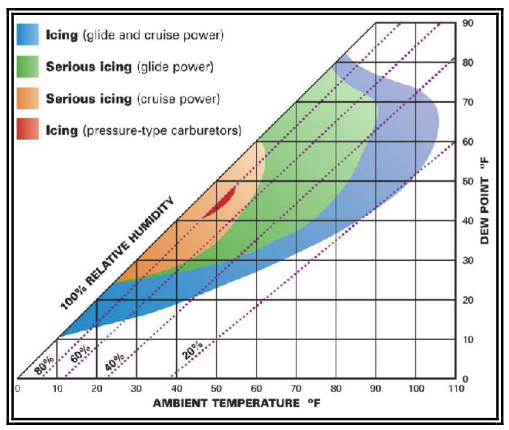
Induction system icing (e.g. carburetor ice)
- Carburetor ice occurs due to the effect of fuel vaporization and the decrease in air pressure in the venturi, which causes a sharp temperature drop in the carburetor.
- If water vapor in the air condenses when the carburetor temperature is at or below freezing, ice may form on internal surfaces of the carburetor, including the throttle valve.
- Carburetor ice is most likely to occur when temperatures are below 70°F (°F) and the relative humidity is above 80%.
- Due to the sudden cooling that takes place in the carburetor, icing can occur even in outside air temperatures as high as 100°F and humidity as low as 50%.
Structural icing: Ice that forms on the airplane's exterior structure
- Ice tends to form on small or narrow objects
- Types of structural icing
- Rime ice: Rough, milkly, opaque ice
- Forms by instantaneous or rapid freezing of super-cooled droplets as they strike the aircraft's surface
- Formed by lower temperatures, smaller amounts of water, and smaller droplets
- Clear ice: Slow accumulation causes smooth, clear, "glazey" ice to form
- Formed by larger amounts of water, high aircraft speed, and large droplets
- Water melts and "runs back" along the wing before it freezes. This can be out-of-reach of you de-icing system
- Typically more dangerous that rime ice
- Mixed ice: A combination of clear and rime ice
- Rime ice: Rough, milkly, opaque ice
Hazards of Structural Icing
- Ice alters the shape of an airfoil, reducing the AOA at which the aircraft stalls
- Note: This may have no effect in cruise but pose a significant risk during approach and landing
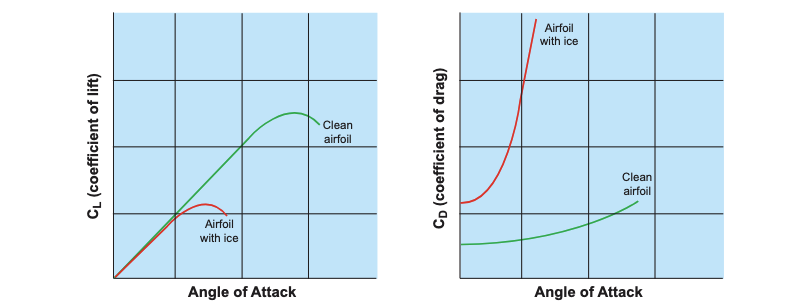
- Ice can partially block or limit control surfaces, making movement ineffective
- Ice also increase aircraft weight
- Roll upset can occur with self-deflection of the aileron
- Ice-Contaminated Tailplane Stall (ICTS)
- Since the horizontal stab is thinner than the main wing, it will accumulate ice quicker
- A tailplane stall can occur when the tailplane exceeds its negative AoA, often after deploying flaps
- This causes the nose to drop
- Be on the lookout for: Sudden changes in elevator effectiveness, force, trim changes, pulsing, osilications or vibrations
- If you suspect a tailplane stall:
- Retract the flaps, if lowered
- Add power and use previous airspeed/attitude combination which gave you S&L flight
- Propeller icing
- Ice tends to form on the spinner and inner radius of the propeller
- This results in a loss of thrust as the propeller is less aerodynamically efficient
- Other icing
- Windshield icing: May severely limit forward visibility
- Stall warning systems: May become immovable (for instance the AoA indicator on a Cirrus)
- Antenna icing: Antennas that do not lay flush with the aircraft’s skin tend to accumulate ice rapidly
- Radio reception may become distorted
- Antennas can also break off with enough ice accumulation
Factors Which Affect Ice Accumulation
- Water content
- Temperature
- Droplet size
- Aircraft design
- Airspeed
PIREP Accumulation rates (AIM 7-1-19)
- Trace: Ice becomes noticeable. The rate of accumulation is slightly greater than the rate of sublimation
- Light: Occasional requires manual activation of the deicing systems. May become hazardous after an hour in the icing conditions
- Moderate: Requires continuous use of the deice system
- Severe: Conditions where the deice system fails to remove ice and accumulates in places normally not prone to icing
Ground Icing: Frost
- Frost may form overnight when the temperature is below freezing and dew forms on the wings
- Just like airframe ice, this can have a significant effect of the aerodynamics of the airfoil and adds weight to the airplane
- Any accumulation of ice or frost should be removed before attempting flight
- How to remove frost: Rag with deicing fluid, deicing fluid spray, or a light brush
Conditions Which Form Ice
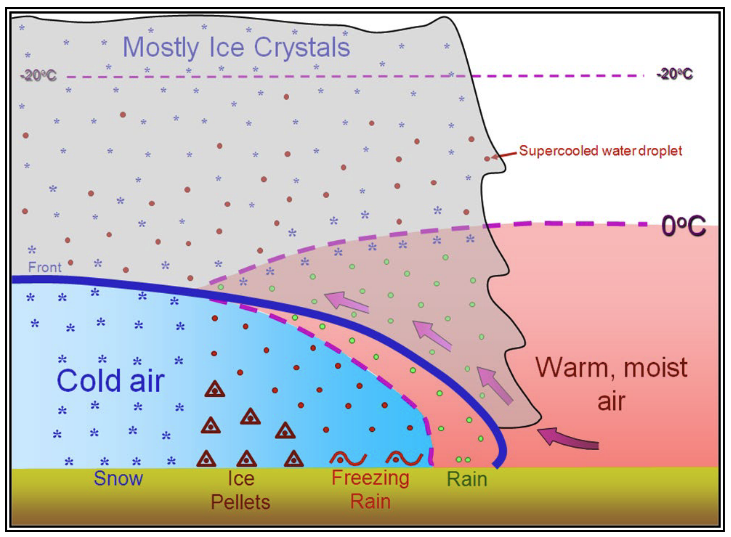
- There is potential for icing anytime you're in visible moisture and the temperature is near or below freezing
- Most ice forms between -20° and 0°
- About half of reports are between -8 °C and -12 °C, and between 5,000 and 13,000 ft.
- Cumulus clouds and thunderstorms
- Ice can form in all levels of a cumulus cloud
- Updrafts make SLDs and cold temperatures in the upper levels of a cumulus
- Strataform clouds:
- Generally trace to light
- Often you can climb/descend out of the cloud, or descend to warmer air
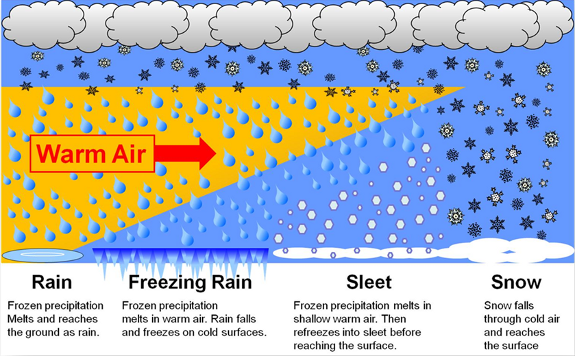
- Freezing rain: Severe ice can accumulate extremely quickly
- Warm fronts can create the potential for freezing rain and supercooled large droplets (SLD)
- Freezing fog
Icing Weather Products
- Freezing level chart
- AIRMETs: Moderate icing and low freezing levels
- SIGMETs: Severe icing
Ice Accumulation Playbook
- Pitot heat ON
- Ice protection system (TKS, boots) ON
- Windshielf defrost: ON
- Determine course out of icing conditions (climb, descend, turn)
- Aircraft-specific inadvertent icing encounter checklist
Removal of aircraft ice in flight
- Ice will sublimate after moving to clear air, but this can be very slow
- Ice will melt if moving to warmer air
Landing with Accumulated Ice
- Be very caution of configuration changes, particularly flaps. Deploy flaps in stages
- Perform a reduced-flap landing on a long runway, if possible
- Carry a higher-than-normal power setting into the approach
- Refer to the POH/AFM for approach airspeed with ice
- Increase approach airspeed by at least 25 percent above non-icing airspeed for the applicable flap setting
Icing regulations: 91.527
- "No pilot may take off an airplane that has frost, ice, or snow adhering to any propeller, windshield, stabilizing or control surface; to a powerplant installation; or to an airspeed, altimeter, rate of climb, or flight attitude instrument system or wing"
- No pilot may fly under IFR into known or forecast light or moderate icing conditions, or under IFR into known light or moderate icing conditions, unless the aircraft is FIKI-certified.
Flight into known icing certification (FIKI)
- "Flight into known icing"
- "Known icing conditions" involve instead circumstances where a reasonable pilot would expect a substantial likelihood of ice formation on the aircraft based upon all information available to that pilot" - Bell AOPA 2009 Legal Interpretation
- FIKI is a certification process that occurs when the aircraft is developed
- Is you aircraft FIKI certified?
- How to tell: AFM or POH references "part 25 appendix C"
- If your A/C has a MEL which includes icing conditions
- Features of a FIKI airplane
- Pitot-heat: Hotter than a no-FIKI model
- Carburetor heat/Alternate air
- Windshield defroster or anti-ice panel
- Wing boots or "weeping wing"/TKS system
- Propeller anti-ice system
- Stall warning system heat
- Fluid quantity gauge (weeping wing system)
- Note some aircraft have the above features but our not FIKI-certified, like our SR22
- Note: Even airplanes approved for flight into known icing conditions should not fly into severe icing, freezing rain or freezing drizzle.
References
- 91.527
- Instrument Flying Handbook pg. 4-13
- AIM 7-1-19: PIREPs Relating to Airframe Icing
- AIM 7-1: Icing Weather Products
- AIM 7-6-15: Operations in Ground Icing Conditions
- Aviation Weather Handbook pg. 20-2
- AC 91-74B
- Article about FIKI
- NASA Icing Course