Forces During Flight
Objective
To understand the effects of the balance of forces on the airplane in different scenarios, and how turning tendencies impact the control of the airplane.
Motivation
Helps a student develop an intuitive understanding of the turning forces present when flying so they can better anticipate and compensate for these forces.
Timing
45 minutes
Format
Elements
Turning Tendencies
- Torque reaction of the propeller: torquing the airplane to roll to the left
- Propeller slipstream/Spiraling slipstream
- Gyroscopic precession
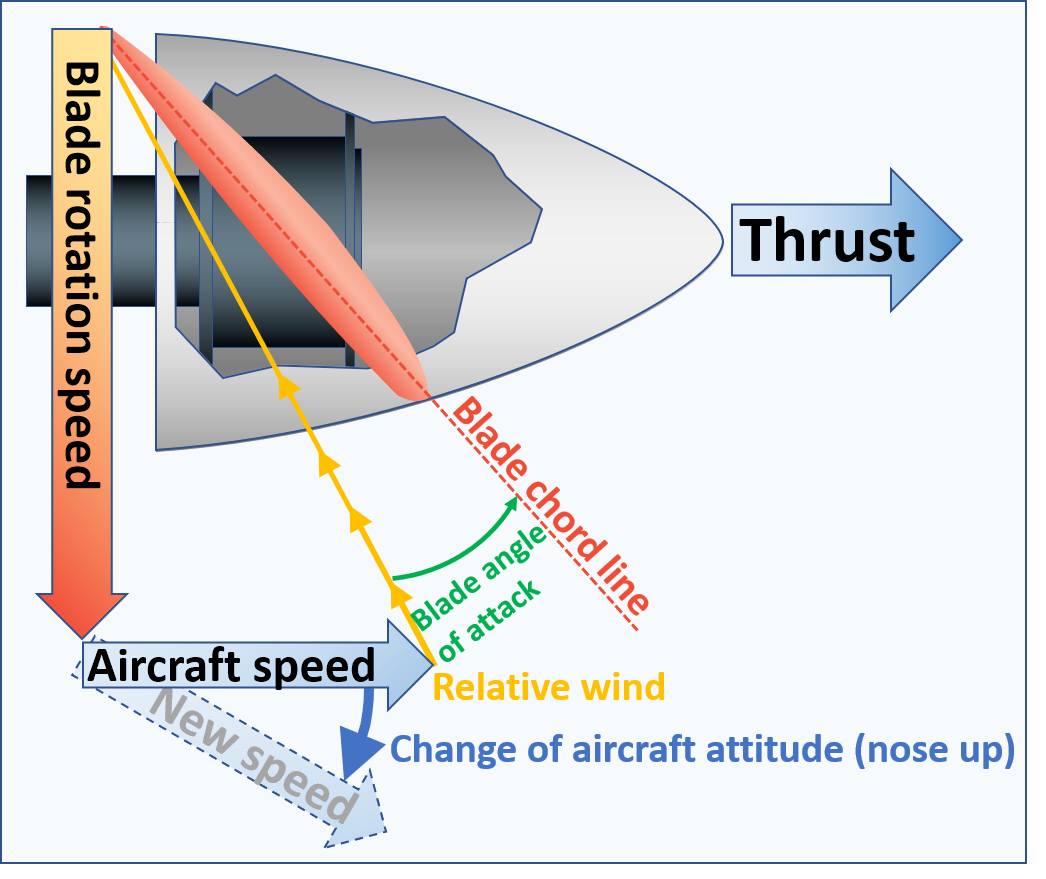
- P-factor / Asymmetric Loading
- With a high AOA, the "bite" of the downward moving blade is greater than the "bite" of the upward moving blade
- Note this can reverse at low AoA, like in a decent
Forces
- Forces in straight and level, unaccelerated flight [force vector diagram]
- Forces in a climb [force vector diagram]
- Forces in a decent [force vector diagram]
- Concept: Acceleration towards center of turn
- "Centrifugal" force as a fictitious force
- Constantly accelerating towards middle of turn
- Forces in a turn
- Lift vector tilts towards center of turn
- Need more lift to remain level
- This lift means more load factor
- For a level turn: Higher bank angle, higher load factor, and thus higher stalling speed
- Stall speed vs bank angle graph
- Beyond 50 degrees load factor in a level turn increases at a huge rate
- Adverse yaw in a turn
- Downward aileron producing less lift, up aileron producing more
- Slip vs skid: Too much rate of turn, too little rate of turn